


Eyelid Surgery (Blepharoplasty)

Eyes are the most powerful focal point on the human face where communication begins and energy is expressed. However, the eye area is also where signs of aging, stress, and fatigue are first observed due to having the thinnest skin and the most sensitive muscle tissue in our body. Medically known as Blepharoplasty, eyelid surgery is the surgical reorganization of excess skin, relaxed muscle tissue, and herniated fat pads (puffiness) in the upper and lower eyelids.
Factors such as the passage of time, gravity, genetic predisposition, and irregular sleep lead to sagging, bagging, and wrinkles in the eyelids. This causes a person to look constantly “tired,” “sleepless,” “sad,” or “older than they are,” regardless of how well-rested or energetic they actually feel. The primary goal of eyelid surgery is to provide the patient with a refreshed and bright gaze that is harmonious with their natural facial features. Furthermore, this surgery is performed not only for aesthetic concerns but also as a functional (medical) necessity in cases where severe sagging of the upper eyelid narrows the visual field.
Why Do Aging Signs Occur in the Eyelids?
Deformations around the eyes are not just a result of advanced age. In many of our patients, significant under-eye bags or low eyelids can be seen even in their 20s and 30s due to genetic factors. The main reasons are:
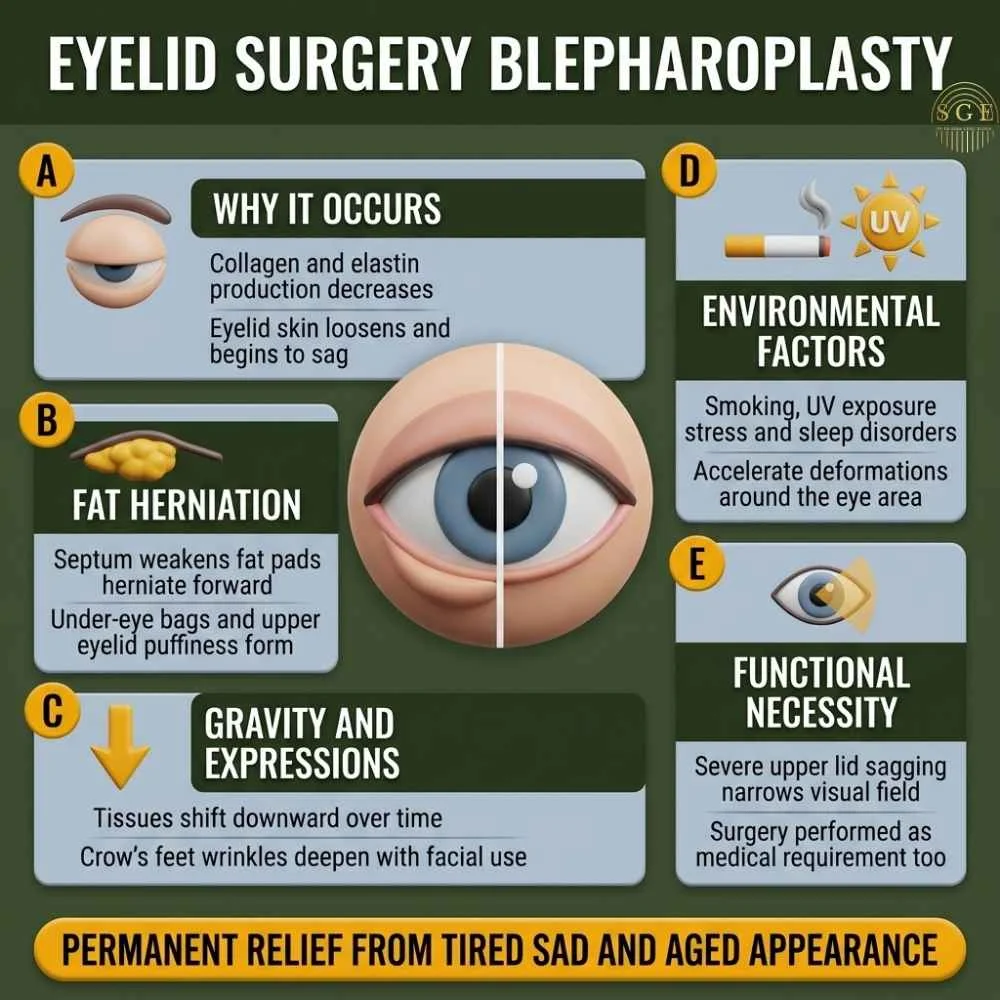
- Loss of Tissue Elasticity: Collagen and elastin production in the skin decreases with age. The eyelid skin, which is the thinnest in the body, loosens and begins to sag (Dermatochalasis).
- Weakening of the Orbital Septum: The membrane layer called the “septum,” which supports the fat pads surrounding the eyeball, weakens over time. This weakening causes fat tissues to herniate forward, creating under-eye bags and upper eyelid swelling.
- Gravity and Facial Expressions: Tissues exposed to gravity for years shift downward. Frequent use of facial expressions contributes to the deepening of wrinkles known as “crow’s feet” around the eyes.
- Environmental Factors and Lifestyle: Smoking, intense exposure to harmful UV rays from the sun, chronic stress, sleep disorders, and irregular nutrition accelerate eye area deformations.
When is Eyelid Surgery Needed?
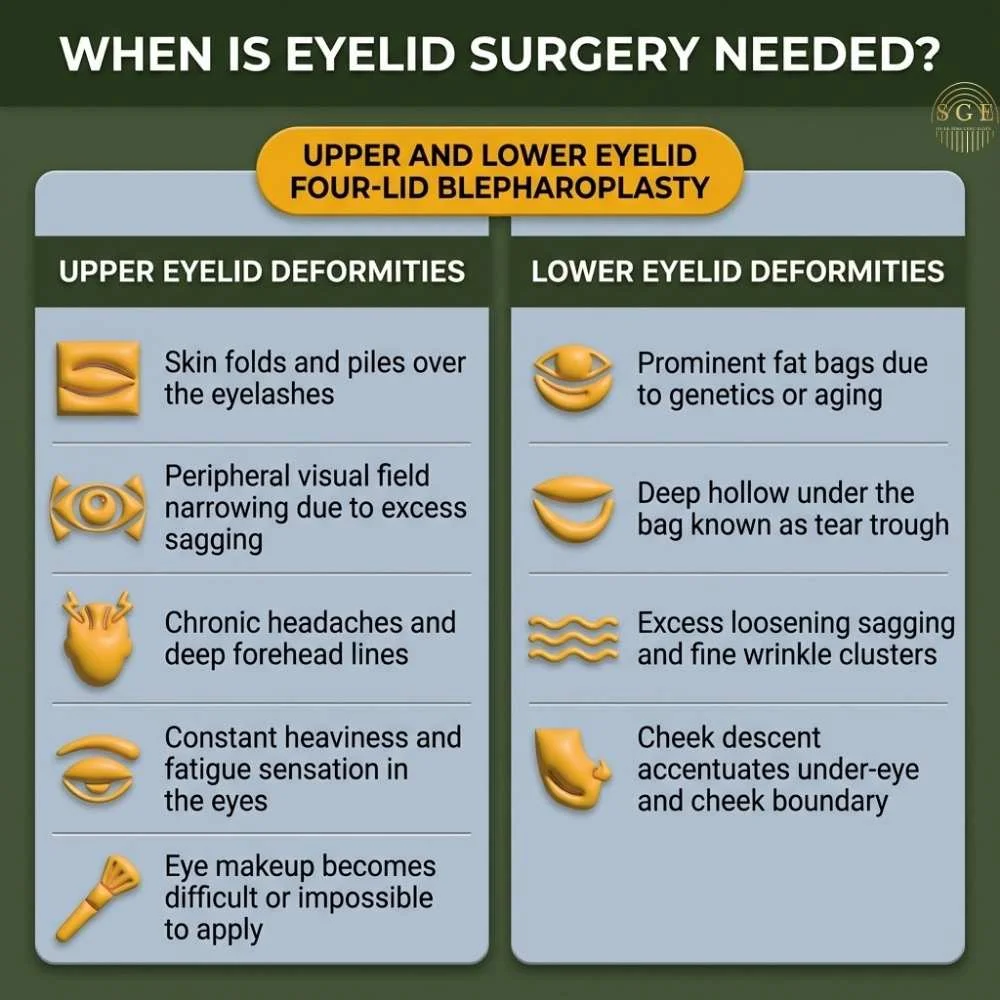
The needs of our patients are generally evaluated in two main categories: upper and lower eyelids. These procedures can be performed alone or, for a flawless integrity, frequently at the same time (Four-Lid Blepharoplasty).
Upper Eyelid Deformations:
- Upper eyelid skin folding and piling up over the eyelashes.
- Narrowing of the patient’s peripheral (side) vision field due to excessive skin sagging.
- Chronic headaches and deep lines on the forehead developing due to the constant use of forehead muscles to lift sagging skin.
- A constant feeling of heaviness and fatigue in the eyes.
- Difficulty or inability to apply eye makeup (especially eyeshadow and eyeliner) for female patients.
Lower Eyelid Deformations:
- Distinctive fat bagging under the eyes developing due to genetic factors or age.
- Deep hollows forming just below the under-eye bags (tear trough deformity).
- Excessive loosening, sagging, and fine wrinkle clusters in the lower eyelid skin.
- The distinction between the under-eye and cheek becoming prominent as cheek tissue sags.
Modern Blepharoplasty (Eyelid Surgery) Techniques
Every patient’s anatomical structure, skin quality, and degree of deformation are different. Therefore, making a “personalized” surgical plan is the most important key to a successful and natural result.
1. Upper Eyelid Aesthetics (Upper Blepharoplasty)
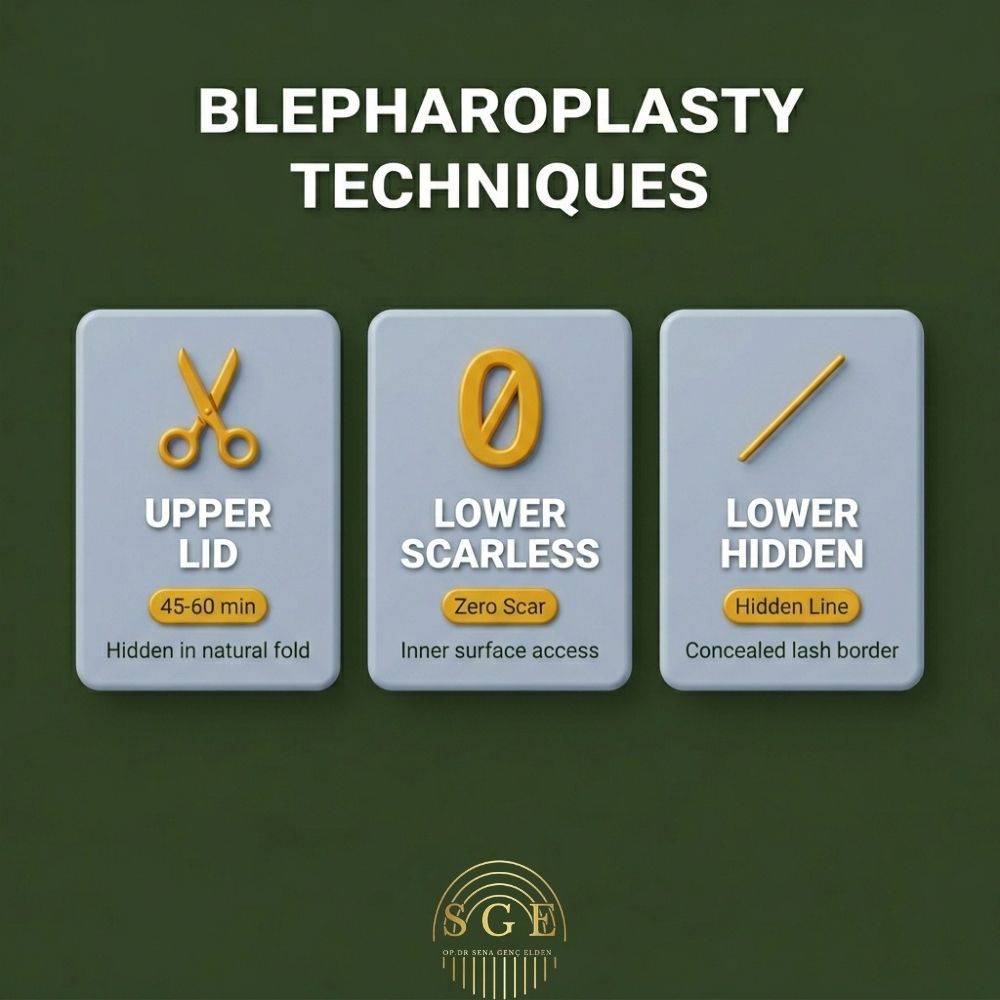
The procedure is usually performed under local anesthesia (numbing only that area). The incision line is planned millimetrically within the natural crease (groove) of the upper eyelid. In this way, the surgical scar is absolutely invisible when the eye is open, hidden within the natural fold. During the operation, excess skin and muscle tissue are millimetrically removed; herniated fat tissues are removed or repositioned if necessary. It is a very comfortable procedure lasting approximately 45-60 minutes.
2. Lower Eyelid Aesthetics (Lower Blepharoplasty)
Lower eyelid surgery is performed with two different modern approaches according to the patient’s needs:
- Transconjunctival Approach (Scarless Technique): This method is preferred if the patient does not have excess skin (sagging) in the lower eyelid and the problem is solely genetic under-eye bags seen at young ages. The incision is made from the inner surface of the eyelid (conjunctival mucosa). Since no incision is made on the skin from the outside, the chance of a scar is zero. Excess fat tissues are removed or spread to hollow areas. The recovery process is extremely fast.
- Subciliary Approach (Eyelash Line Incision): It is performed in older patients or patients with both fat bagging and significant skin sagging in the lower eyelid. The incision is made approximately 1-2 millimeters below the lower eyelashes, parallel to the lash line. Excess skin and relaxed muscle tissue are removed, and fat bags are corrected. Since the incision scar is hidden at the lash line, it is not noticed from the outside once healing is complete.
3. Fat Repositioning
In traditional lower eyelid surgery, fat bags were completely removed and discarded; however, this could lead to a hollow (skeletonized) appearance under the patient’s eyes in later years. In the modern approach (especially in patients with hollowing), these excess fat tissues are not removed; instead, they are spread and fixed to the lower areas to fill (level) the hollows in the tear trough and cheek transition. Thus, a completely smooth, youthful transition from the under-eye to the cheek is achieved.
Comparative Table: Eyelid Aesthetic Applications
| Criteria / Application | Upper Blepharoplasty | Lower Blepharoplasty (Transconjunctival) | Lower Blepharoplasty (Subciliary) |
| Primary Goal | Removing sagging skin and heaviness, opening the visual field | Removing/spreading fat bags (For those without skin sagging) | Simultaneously addressing sagging skin, wrinkles, and bags |
| Anesthesia Type | Local Anesthesia | Local or Sedation | Sedation or General Anesthesia |
| Incision / Scar Status | Hidden in the eyelid crease | Zero external scar (Incision from inside the lid) | Hidden incision at the eyelash line |
| Recovery Time | Average 5-7 Days | Average 3-5 Days | Average 7-10 Days |
| Procedure Time | ~45 – 60 Minutes | ~45 – 60 Minutes | ~1.5 – 2 Hours |
Step-by-Step Treatment and Recovery Process
Eyelid surgery is one of the operations where the recovery process is the most comfortable and painless compared to other aesthetic operations in the body.
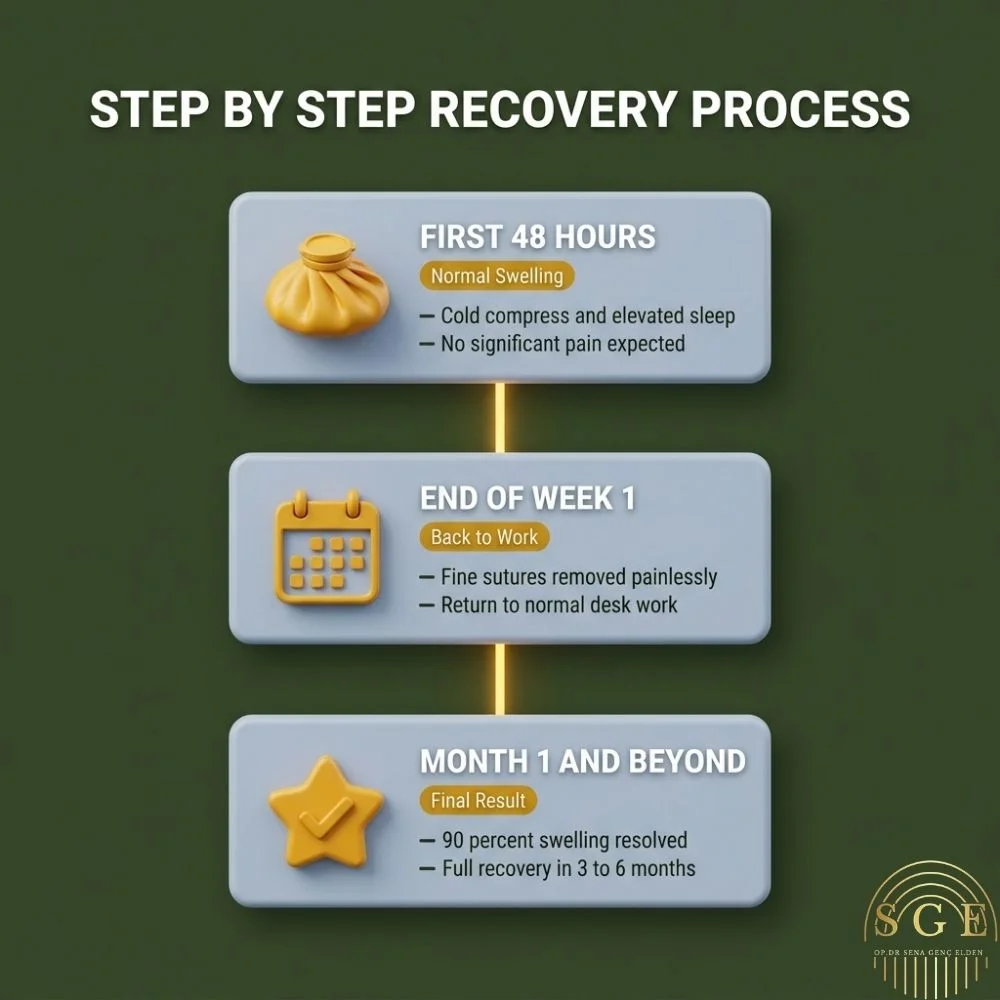
1. First 48 Hours Post-Operation: There are thin tapes on the eyelids immediately after the surgery. The patient’s eyes are not closed; there is nothing preventing them from seeing. It is normal to have minor leakage into the tissue, slight swelling (edema), and minimal bruising (ecchymosis) according to the person’s skin structure for the first 2 days. Pain is not expected; if present, a slight aching sensation disappears immediately with simple painkillers. Cold compress application (ice application) for 10-15 minutes every hour and sleeping with the head elevated with two pillows ensures that the edema subsides quickly.
2. End of the First Week: During the first check-up on the 5th or 6th day of the surgery, any very thin stitches that need to be removed are taken out painlessly (mostly self-dissolving stitches or special tissue glues are used). Once stitches are removed or tapes are taken off, the patient can easily return to their normal desk job. Any remaining slight yellowing can be easily camouflaged with sunglasses or concealer makeup products (with doctor’s approval) can be used.
3. First Month and Final Result: Within 3-4 weeks after the operation, 90% of the edema is expelled from the body. Incision scars begin to turn from pink to the patient’s own skin color. The heavy, tired, and sleepless appearance around the eyes is replaced by a refreshed, bright, and energetic expression. Full recovery and tissues reaching their final form are completed between 3 and 6 months.
Frequently Asked Questions (FAQ)
You can quickly access answers to the most common questions and find detailed information about the treatment process here.
Is eyelid surgery dangerous? Does it harm my eye or vision?
No, blepharoplasty surgery does not harm visual functions. The surgical intervention is performed only on the skin, muscle, and fat tissues surrounding the eyeball, not on the eyeball itself. When performed by an expert surgeon, the procedure does not carry a risk related to vision. On the contrary, in patients with severely sagging upper eyelids, the visual field expands and visual quality increases after the operation.
Will there be scars in eyelid surgery?
As in all surgical procedures, a micro-level scar occurs because an incision is made in blepharoplasty. However, the eyelid skin is the area in our body that heals fastest and leaves the least scar. Since the scar is hidden in the crease of the upper eyelid and at the lash line in the lower eyelid, it is almost impossible to see it with the naked eye from a speaking distance once healing is complete.
Do non-surgical eyelid aesthetics (Plasma/Plexr, Laser) work? Are they alternatives to surgery?
Non-surgical device-supported procedures such as plasma energy or laser can provide minimal tightening only in very early-stage mild skin loosening. However, these methods do not work in cases with significant skin sagging (folding) or fat herniation (bagging). The real and permanent solution is only the surgical removal of excess tissue.
Are the results of eyelid surgery permanent?
The results obtained in eyelid surgery are quite long-lasting. The effect of upper eyelid aesthetics lasts an average of 10-15 years depending on the person’s lifestyle and genetics, while the effect of the procedure to remove/correct under-eye bags is generally permanent for a lifetime. Surgery does not stop time, but the clock of your eyelids is turned back.
When can I use lenses and makeup after the surgery?
There may be slight sensitivity around the eyes to protect the cornea during the operation. After upper or lower eyelid surgeries, it is generally recommended not to use contact lenses for 1 week to 10 days, and to prefer prescription glasses instead. Light eye makeup can be applied after the stitches are removed and the incision sites are completely closed (usually from the 7th-10th day).

Op. Dr. Sena Genç Elden
Otolaryngologist (ENT Specialist)
Op. Dr. Sena Genç Elden, following her medical and residency training, completed Facial Plastic Surgery School and gained experience as a chief physician; she possesses national and international clinical expertise alongside world-renowned surgeons and currently continues her practice at her own private clinic in Serdivan, Sakarya.
Take the First Step for a New Beginning!
Address:
Contact Us
Mail: info@drsenagencelden.com
The Ideal Balance of Aesthetics and Health
A successful aesthetic surgery process not only improves your external appearance but also directly enhances your quality of life. In our clinic, we meet both your aesthetic expectations and functional needs at the highest level with personalized modern surgical approaches that respect the unique anatomy of your face. You can create your preliminary consultation appointment right away to plan the most suitable treatment together and find answers to the questions in your mind.
References and Scientific Basis
Ensuring our patients have access to the most accurate and up-to-date medical information is a fundamental principle of our clinic. The medical data on this treatment page has been compiled referring to the guidelines of the following international authorities:
International Clinical Guidelines;
Mayo Clinic: Blepharoplasty (Eyelid Surgery) – Overview, Procedure, and Results.
American Society of Plastic Surgeons (ASPS): Eyelid Surgery (Blepharoplasty) Candidates and Recovery.
Cleveland Clinic: Blepharoplasty (Eyelid Surgery) Details and What to Expect.
Academic Publications (Surgeon Dr. Sena Genç Elden) ;
- Elden, S. G., et al. (2024). Diagnostic Value of the Video Head Impulse Test in Patients with Vertigo: Can It Be Used as a Screening Tool? ResearchGate
- Elden, S. G., & Güven, E. M. The Effect of Hypericum Perforatum L. (St. John’s Wort) on Prevention of Myringosclerosis After Myringotomy. ResearchGate
- Genç Elden, S., & Demir, D. Investigation of diclofenac sodium’s ototoxic and neurotoxic effects on the rat model. ResearchGate