


Ear Aesthetics (Otoplasty)

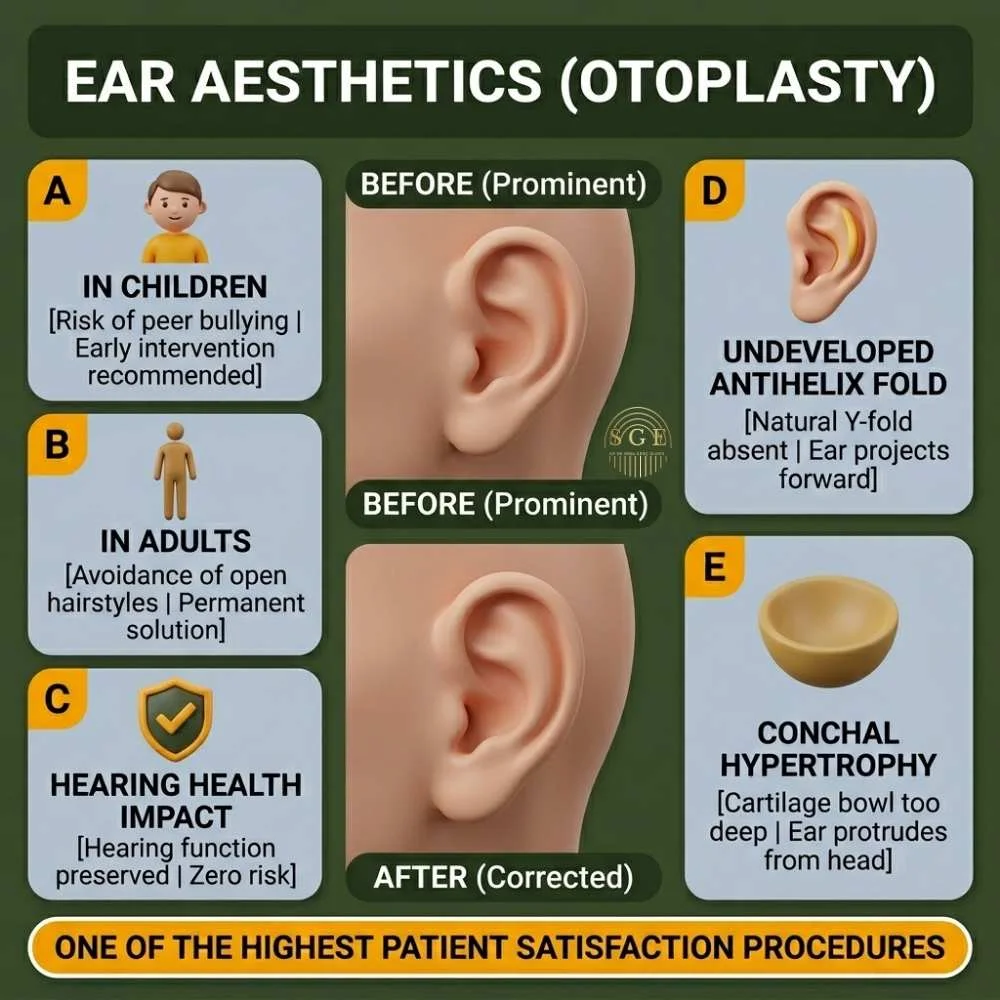
One of the most important complementary elements of facial aesthetics and overall head-neck proportions is our ears. Ear structures that deviate from their natural form, appearing more prominent, protruding forward, or positioned asymmetrically, are referred to in medical literature as “Prominent Ear” deformity. Ear aesthetics, medically known as Otoplasty, is a surgical procedure that reshapes the size, form, and angle of the ear cartilage relative to the skull, ensuring a natural, harmonious, and aesthetic proportion with the rest of the face.
Beyond the vital role ears play in our physical health and hearing function, their aesthetic appearance has profound effects on our psychological and social lives. This condition—which can lay the groundwork for peer bullying, especially in school-aged children, and cause adults to feel compelled to constantly leave their hair down or feel self-conscious during daily activities like tying their hair up or wearing a hat—can be permanently resolved with otoplasty. In modern aesthetic surgery, otoplasty is one of the operations with the highest patient satisfaction and success rates, where we reshape the cartilage memory to create natural folds without damaging hearing functions in any way.
What Causes Prominent Ear Deformity and What is its Anatomical Basis?
The prominent ear condition, which creates the need for ear aesthetics, is not a disease but entirely an anatomical variation and structural difference. Almost entirely genetically inherited, this condition stems from minor deviations in the shaping process of the cartilage structure during fetal development in the womb. There are two primary anatomical factors that cause the auricle (outer ear) to appear different from normal:
Underdevelopment of the Antihelical Fold: This is the absence or severe flatness of the natural “Y” shaped fold (antihelix) that the cartilage should form by folding inward on the upper half of the ear. The lack of this fold causes the upper part of the ear to extend straight outward and forward like a scoop.
Conchal Cartilage Hypertrophy (Overgrowth): This occurs when the bowl-shaped cartilage structure (concha) located just around the ear canal is deeper or larger than normal, or the angle it forms with the skull bone is too wide. This condition causes the entire ear to move away from the head and protrude forward.
In most patients, these two anatomical conditions are seen simultaneously, and in the planned otoplasty surgery, both issues are addressed at the same time to target flawless harmony.
Who is Suitable for Ear Aesthetics (Otoplasty)? What is the Ideal Age?
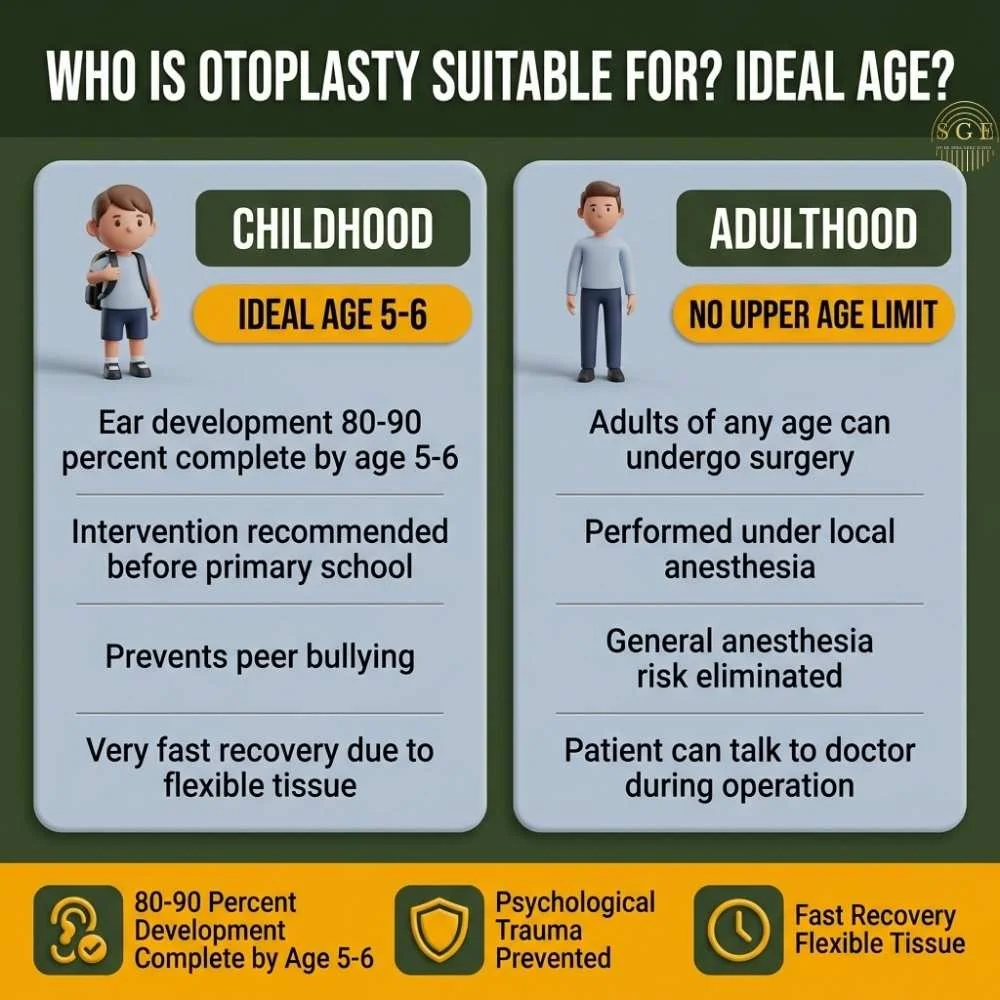
Otoplasty is one of the rare aesthetic surgery operations that is not only approved but also highly recommended to be performed during childhood (pre-school period). The main reason for this is that ear cartilage development is completed at a very early age, and there is a desire to prevent potential psychological trauma.
- Childhood Period: The human ear completes about 80-90% of its physical development between the ages of 5 and 6. Therefore, the ideal time for otoplasty is the 5-6 year period before the child starts primary school. This protects the child from psychological traumas that could damage their self-confidence and school performance, such as “being teased” or “peer bullying” they might encounter in a school environment. Since the tissues in this age group are much more flexible, recovery is incredibly fast.
- Adolescence and Adulthood: There is no upper age limit for otoplasty. Any adult who did not have the opportunity to undergo this operation during childhood and has had to hide their ears with hair or accessories for years can have ear aesthetics. In adult patients, the operation is usually performed with only local anesthesia (regional numbing), thus eliminating anesthesia risks and allowing the patient to chat with their doctor during the procedure.
Modern Otoplasty Techniques Used
Since every patient’s ear structure, cartilage stiffness, and skin thickness are different, it is not possible to speak of a single standard method. As a result of a detailed clinical examination, the most appropriate technique for your needs is determined.
1. Classic Surgical Otoplasty (Cartilage Shaping Method)
This is the most permanent and widely used gold standard method. The procedure is performed entirely through an incision made in the back fold of the ear (the line where it meets the skull). How is it Applied? The surgeon accesses the cartilage tissue from behind the ear. To create the antihelical fold, the cartilage membrane is thinned or scored using special techniques. Invisible, permanent medical sutures are used to fold the cartilage backward and bring it closer to the skull to hold the ear at the correct angle. Advantages: The results are lifelong. The possibility of recurrence (the ear returning to its former state) is almost non-existent. It is the most effective solution for severe asymmetries and stiff cartilage structures. Since the incision remains completely behind the ear, no scar is visible from the outside.
2. Thread Otoplasty (Non-surgical / Incisionless Technique)
This is the process of pulling the ear backward using only special needles and permanent surgical threads without using an incision (scalpel). How is it Applied? Micro-holes are opened behind the ear, permanent threads are passed through the cartilage, and the threads are pulled to give the ear the desired angle. Advantages and Disadvantages: The procedure time is very short (about 15-20 minutes), there is no bleeding or bruising, and the recovery process is very comfortable. However, this method is not suitable for every patient. It can only be preferred for patients with very soft cartilage structures and mild deformities. Compared to classic surgery, the risk of the threads loosening and the ear returning to its former state over time (recurrence) is relatively higher.
Comparative Table: Otoplasty Techniques
| Feature / Technique | Classic Surgical Otoplasty | Thread (Incisionless) Otoplasty |
| Incision Status | Hidden incision in the unseen fold behind the ear | No incision, micro-holes opened with a needle |
| Permanence | Lifelong permanence (High reliability) | Moderate level (Risk of thread loosening/opening) |
| Procedure Time | Average 1.5 – 2 Hours | Average 20 – 30 Minutes |
| Cartilage Intervention | Cartilage is filed and reshaped | Only a mechanical pulling force is applied with threads |
| Suitable Patient Profile | All types of ear structures, asymmetries, and deformities | Only mild cases with very thin/soft cartilage |

Step-by-Step Treatment and Recovery Process
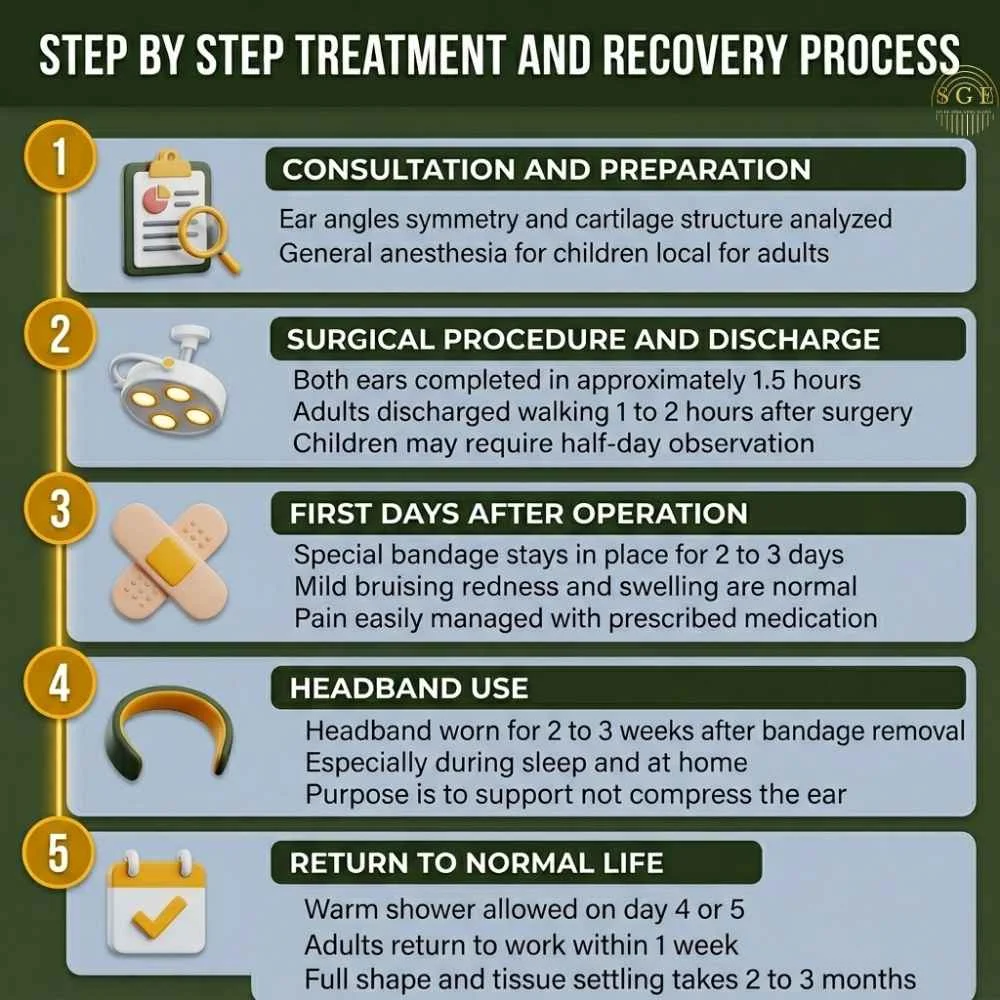
1. Consultation and Preparation: In the first stage of the process, the angles the ears make with the skull, the symmetry of both ears, and the cartilage structure are analyzed. While the operation is planned under general anesthesia (putting the patient to sleep) for child patients, local anesthesia supported by sedation is generally preferred for adult patients and those older than 12-15 years.
2. Surgical Intervention and Discharge: During an operation performed under local anesthesia, the patient feels no pain, only touches. The procedure takes a total of about 1.5 hours for both ears. At the end of the surgery, a protective and compressive dressing bandage is applied over the ears. Adult patients can walk out of the hospital or clinic and return home 1-2 hours after the operation. Child patients may require half a day of observation for monitoring purposes.
3. First Days Post-Operation (Home Care): The special dressing applied remains in place for the first 2-3 days. This dressing suppresses possible edema (swelling) and helps the cartilage adapt to its new form. When the dressings are opened, it is normal to see slight bruising, redness, and swelling on the ears. For the first few days, a mild aching pain may be felt; this condition is easily controlled with painkillers prescribed by your doctor.
4. Headband Use (Tennis Band): After the dressings are removed, the patient is asked to wear a sports band (tennis headband) or a cotton hairband for about 2 to 3 weeks (especially while lying down and inside the house). The purpose of this band is not to protect the ears from excessive pressure, but to prevent the patient from accidentally turning during sleep, folding their ear, and damaging the stitches with an awkward movement. The band should not be too tight; it should only support the ear.
5. Return to Normal Life: Patients can take a warm shower on the 4th or 5th day post-operation (protecting the stitches behind the ear with special waterproof tapes). Adults can generally return to work within 1 week. Since the stitches placed behind the ear are mostly of the self-dissolving (absorbable) type, there is no need for the stress of stitch removal. It takes a period of 2-3 months for the ear to fully find its shape, for the edema to be completely expelled, and for the tissues to settle.
Frequently Asked Questions (FAQ)
You can quickly access answers to the most common questions and find detailed information about the treatment process here.
Does ear aesthetic (Otoplasty) surgery damage hearing?
Absolutely not. The area intervened in otoplasty surgery is only the externally visible “auricle” and cartilage part of the ear. There is no anatomical connection between the surgical area and the middle ear, eardrum, and inner ear organs that provide hearing functions. Therefore, it is medically impossible for the operation to reduce hearing ability or damage hearing.
Is otoplasty surgery very painful?
Since anesthesia (local or general) is applied during the operation, zero pain is felt. In the first 48 hours following the surgery, there may be a mild-to-moderate throbbing ache due to the tension created by the new shape given to the cartilage. This ache is very easily tolerated with routine painkillers. Within a few days, this feeling of tension completely disappears.
Is the scar left behind the ear visible after the surgery?
In operations performed with the classic method, the incision is made from the back fold area (sulcus) where the ear meets the skull. Therefore, it is impossible to see the incision scar when viewed from the front, side, or back. Furthermore, the healing potential of the area is very high; the scar fades within months, turning into an indistinct fine line.
Will the operated ear return to its former state (prominent) years later?
After a successful otoplasty surgery performed with the classic surgical method (where the cartilage membrane is weakened and shaped with permanent threads), the probability of the ear returning exactly to its former state is very low (1-2%). In extreme situations, such as receiving a heavy blow in the early period or the patient not using the ear band regularly with a very stiff cartilage structure, a slight opening (asymmetry) may occur, but this condition can be immediately corrected with a minor revision. In the “thread suspension” method, the risk of recurrence is higher.
When can I swim in the sea or play sports after ear aesthetics?
To allow the incision sites to fully heal and eliminate the risk of infection, entering pools and the sea is not recommended for at least 4 weeks following the operation. Similarly, to ensure the cartilage adapts securely to its new position, heavy sports involving contact where the ears could receive a blow (boxing, wrestling, football, etc.) should be avoided for the first 4-6 weeks. Light-paced walks can be started 1 week after the operation.

Op. Dr. Sena Genç Elden
Otolaryngologist (ENT Specialist)
Op. Dr. Sena Genç Elden, following her medical and residency training, completed Facial Plastic Surgery School and gained experience as a chief physician; she possesses national and international clinical expertise alongside world-renowned surgeons and currently continues her practice at her own private clinic in Serdivan, Sakarya.
Take the First Step for a New Beginning!
Address:
Contact Us
Mail: info@drsenagencelden.com
Refresh Your Confidence, Tie Your Hair Up Freely
That new chapter where you take your self-confidence to the top and feel no need to hide your ears is much closer than you think. With a highly comfortable and short recovery process, you can bid a lifelong farewell to your aesthetic concerns. To detail the most suitable otoplasty solution for your cartilage structure and take the first step towards the appearance of your dreams, you can contact us to schedule your appointment.
References and Scientific Basis
The medical information presented on this page has been prepared with reference to the guidelines of international health and aesthetic surgery authorities, ensuring our patients reach the most reliable sources:
International Clinical Guidelines;
Mayo Clinic: Otoplasty (Ear Surgery) – Overview, Procedure Details, and Risks.
American Society of Plastic Surgeons (ASPS): Ear Surgery (Otoplasty) Candidates, Recovery & Results.
Cleveland Clinic: Otoplasty (Ear Pinning Surgery) Details and What to Expect.
Academic Publications (Surgeon Dr. Sena Genç Elden) ;
- Elden, S. G., et al. (2024). Diagnostic Value of the Video Head Impulse Test in Patients with Vertigo: Can It Be Used as a Screening Tool? ResearchGate
- Elden, S. G., & Güven, E. M. The Effect of Hypericum Perforatum L. (St. John’s Wort) on Prevention of Myringosclerosis After Myringotomy. ResearchGate
- Genç Elden, S., & Demir, D. Investigation of diclofenac sodium’s ototoxic and neurotoxic effects on the rat model. ResearchGate